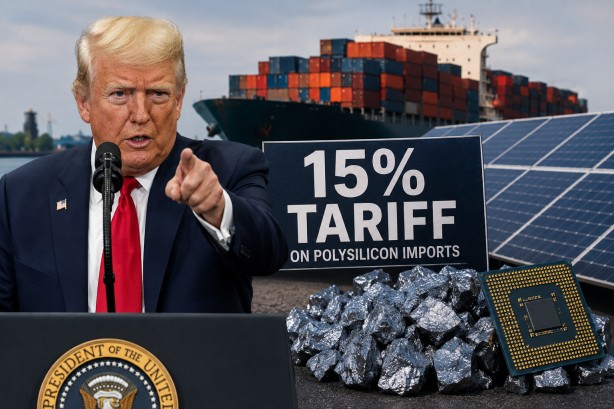
In a bid to bolster domestic production and reduce dependence on Chinese imports, US President Donald Trump has announced a 15% tariff on imported products made with polysilicon, a crucial material in the production of semiconductors and solar panels. The tariff, which is set to take effect on December 4, also introduces minimum import prices for various polysilicon products, including $21 per kilogram for the material itself, $100 per kilogram for ingots and wafers, $0.22 per watt for solar cells, and $0.38 per watt for solar modules and panels.
Polysilicon is a highly refined form of silicon essential for manufacturing semiconductors used in artificial intelligence systems and data centers, as well as solar cells. Currently, China dominates the global production of this material. The US government’s new measures are designed to enhance the commercial viability of domestic polysilicon production, which is crucial for maintaining significant supply chains tied to both economic and national security interests.
While the US aims to support its domestic industry through this tariff, China has criticized the action, accusing the US of improperly using national security concerns to impose restrictions on Chinese businesses. Beijing warns that such protectionist measures could potentially disrupt trade relations between the two countries, which are already tense.
Currently, the US hosts two major polysilicon production facilities, operated by Hemlock Semiconductor in Michigan and Wacker Chemie in Tennessee. The new policy not only imposes tariffs but also paves the way for the US government to offer incentives to companies investing in domestic polysilicon and related manufacturing facilities.
This development comes amid China’s continued growth in exports, especially in sectors like electronics and artificial intelligence, which are integral to high-value manufacturing. The US administration’s move reflects an ongoing strategy to secure critical supply chains and support domestic industries in the face of international competition.
