
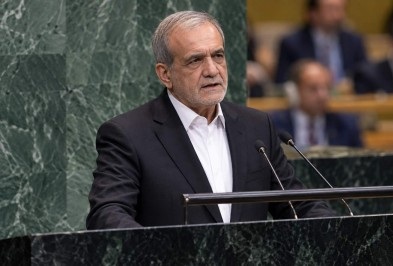
Iranian President Masoud Pezeshkian addressed the United Nations General Assembly, expressing criticism of U.S. President Donald Trump while emphasizing Iran’s willingness to engage in diplomatic talks. Pezeshkian highlighted that while Tehran is open to negotiations, it will not negotiate under threats or military pressure.
The Iranian leader’s comments followed remarks by Trump, who mentioned the possibility of further U.S. action against Iran during his own address at the UN. Despite the tensions, diplomatic efforts continued as Iranian Foreign Minister Abbas Araghchi met with U.S. special envoy Steve Witkoff for three hours. The meeting, mediated by Qatar, focused on conditions necessary for reducing tensions and easing pressures on Iran.
Pezeshkian reiterated Iran’s stance on maintaining a peaceful nuclear program, asserting that the country does not seek nuclear weapons. He also called for regional cooperation on security issues, suggesting that local countries should reduce reliance on external powers.
A significant point of contention in the discussions is the strategic Strait of Hormuz, a critical waterway for global shipping and energy. Iran has suggested that the reopening of the Strait is contingent upon the cessation of military pressure and economic sanctions, along with the release of Iranian assets.
Iranian officials have outlined specific conditions for easing tensions, including lifting the naval blockade and economic restrictions, as well as ending hostilities. Pezeshkian accused the United States and Israel of aggression but defended Iran’s actions as necessary for self-defense amid ongoing economic challenges and sanctions.
The recent diplomatic interactions at the UN indicate that despite deep-seated disagreements between Washington and Tehran over issues such as sanctions and Iran’s nuclear ambitions, avenues for dialogue remain open.
