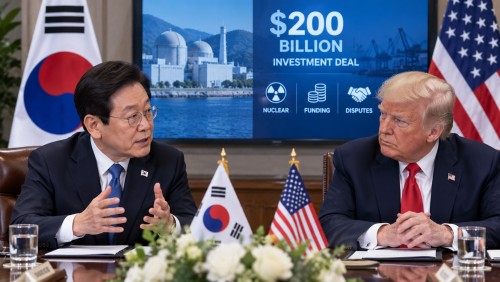
South Korea and the United States are grappling with significant differences over nuclear power projects and financial commitments, casting uncertainty over Seoul’s ambitious $200 billion investment plan in the U.S. The countries are in discussions about constructing eight nuclear reactors in the United States, but disagreements over reactor designs and investment structures remain unresolved.
The negotiations are particularly strained over the choice of nuclear reactor designs. The proposed plan includes six reactors based on Westinghouse’s AP1000 design and two using South Korea’s APR1400 technology. However, U.S. officials and Westinghouse have expressed opposition to incorporating the Korean-designed APR1400, complicating efforts to finalize the nuclear agreement. Additionally, South Korea seeks a 15% to 20% stake in Westinghouse, while the company prefers to limit Seoul’s ownership to below 10%.
Financial scheduling is another sticking point in the talks. Washington has requested over $9 billion from South Korea by the end of the year, whereas Seoul had planned to start with a smaller investment in 2026, ramping up contributions from 2027. These differences in funding timelines add to the complexity of reaching a consensus on the investment package.
South Korea’s potential participation in a U.S. project for processing spent nuclear fuel is also under consideration. Additionally, Seoul is evaluating its involvement in a proposed liquefied natural gas project in Alaska, although concerns over construction costs and long-term returns persist.
Another challenge involves how investment returns and losses are calculated. South Korea proposes that profits from successful projects should offset losses from unsuccessful ones, while the U.S. prefers separate accounting for each project. The proposed framework would see the U.S. receiving 90% of net profits after recovering principal and interest, but Seoul is wary that this could leave it bearing losses from failed ventures.
Despite these hurdles, both governments continue to negotiate the terms of the investment package. According to South Korea’s Industry Ministry, discussions are ongoing, and no final decisions have been made regarding the projects, funding structure, and investment arrangements.
